
What Is the Purpose of Silicon in Casting? (3–10 mm and 10–60 mm)
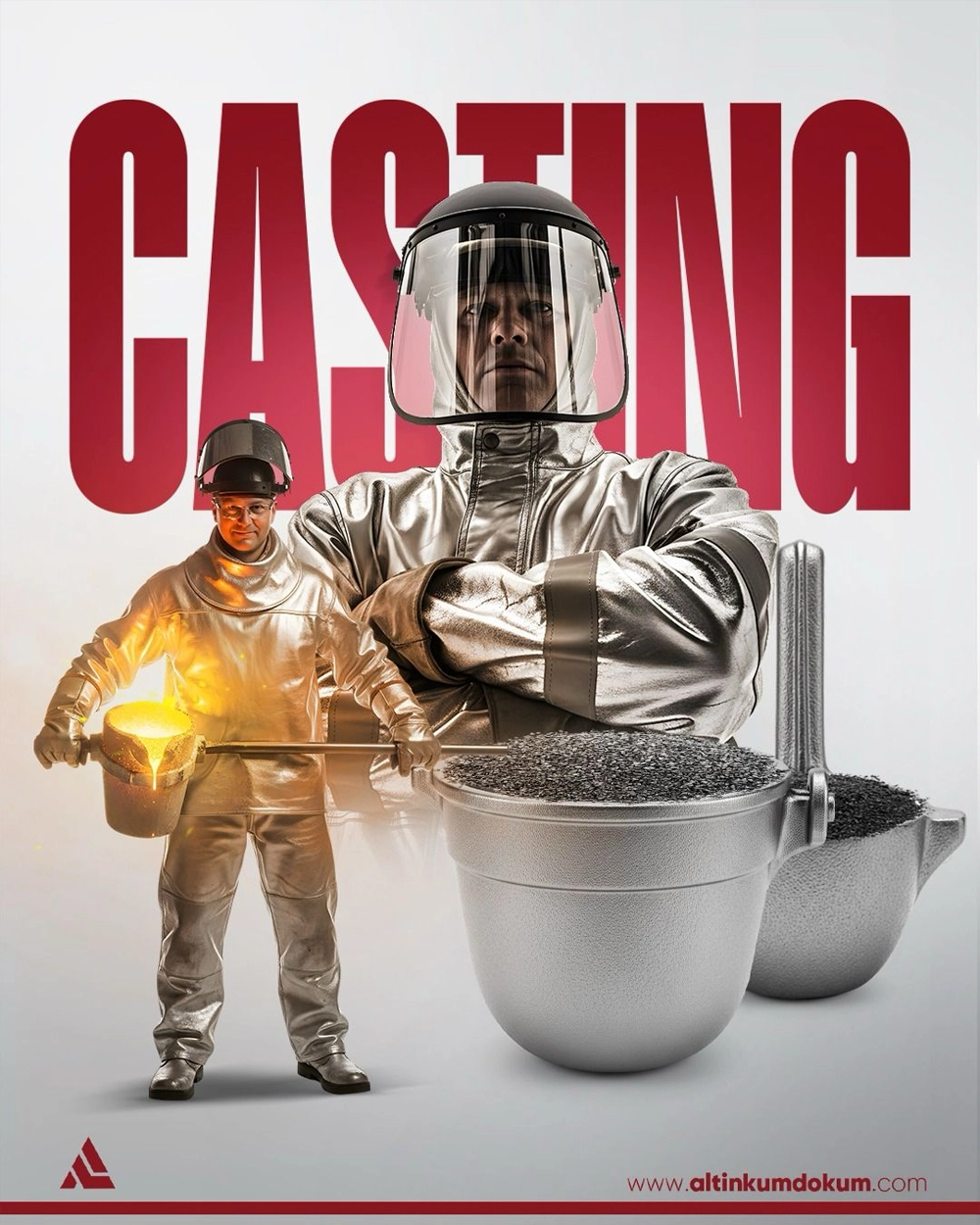
Casting silicon is a source of metallic silicon / silicon lumps used to adjust the silicon content during cast iron and ductile iron melting. Silicon supports graphitization, affects fluidity, and plays a critical role in balancing mechanical properties. If the target Si level is not achieved, the carbon equivalent (CE) may deviate, cooling behavior can be affected, and microstructural control becomes more difficult. At Altınkum Döküm, the most frequently requested particle size ranges are 3–10 mm and 10–60 mm. The finer fraction dissolves more quickly, while the coarser fraction helps control oxidation losses in large ladles and furnace charges.
Silicon particle size should be selected according to the addition point and molten metal temperature. Very fine material may oxidize on the surface or become lost in the slag, while excessively coarse material may settle at the bottom of the ladle before fully dissolving and may appear as “insufficient Si” in spectrometer analysis. Therefore, even the same silicon quality can perform inefficiently if the particle size is incorrectly selected. The 3–10 mm fraction is generally preferred for more controlled ladle adjustments, while the 10–60 mm fraction is typically used for high-tonnage charges and furnace additions.
Silicon adjustment can also be carried out using ferrosilicon; however, metallic silicon is selected in some processes for higher silicon recovery and a cleaner molten bath. Since the iron input differs compared with ferrosilicon, the charge calculation should be adjusted accordingly. Excessive silicon can increase the risk of cold brittleness, promote undesirable phases, and cause the composition to fall outside the target grade. Therefore, increasing Si should not be approached with the idea that “more is always better”; it should be controlled according to the spectrometer target and the required casting grade.
In practice, silicon should be evaluated together with carbon and manganese adjustments. Especially in ductile iron production lines, if the chemistry is not stable before nodulization, magnesium recovery and inoculation effectiveness may also be affected. A consistently used casting silicon is one of the most practical tools for balancing variations in scrap composition and maintaining the same CE range in every charge. Keeping the correct particle size in stock also helps maintain production continuity during urgent Si adjustments.
Silicon in 3–10 mm and 10–60 mm particle sizes is available for fast delivery from our Konya Central and Ankara branches. Based on your furnace type, ladle capacity, and target silicon range, we can determine together which fraction will provide the most efficient results. At Altınkum Döküm, our goal is to provide the right silicon selection for clean dissolution, predictable spectrometer results, and reduced unnecessary alloy consumption.
